
Health Information
https://www.techtransfer.nih.gov/tech/tab-3391
Law Enforcement and Military
Lead Exposure at Ranges

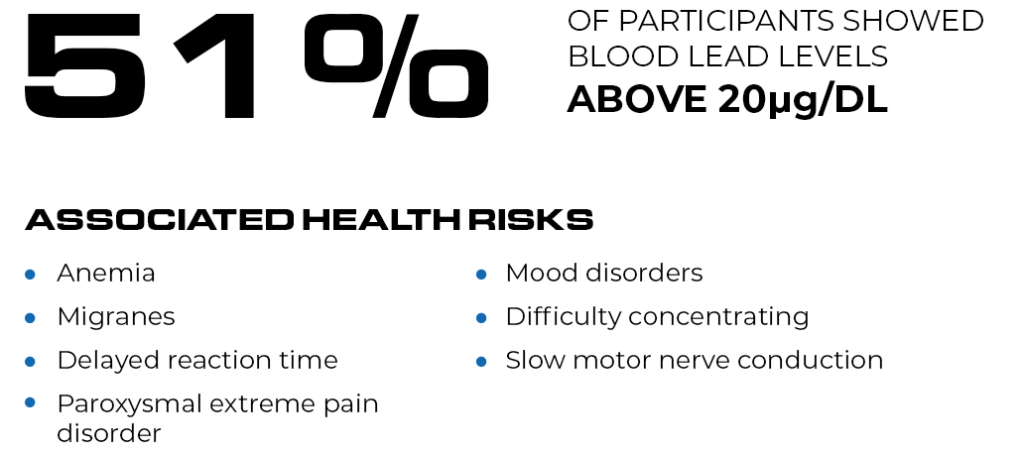
The National Library of Medicine reviewed 36 studies on shooting range lead exposure, targeting law enforcement and military shooters. The review found that almost all participants had blood lead levels (BLL) surpassing CDC and NIOSH safety guidelines. Given that the average adult BLL is only 0.92 μg/dl—well below the 5 μg/dl threshold for elevated risk—these results are significant. Although the body can process lead, consistent exposure that maintains BLLs above 5 μg/dl significantly increases the risk of health complications.
Beyond the air quality issues at shooting ranges, lead dust accumulates directly on skin and clothing. Although tools like suppressors, respirators, and proper ventilation reduce inhalation risks, they cannot eliminate surface residue. This residue poses a significant health threat when transferred via eating or touching the nose, mouth, or eyes. Unfortunately, traditional soaps and detergents are insufficient for removing lead, making specialized cleaning solutions like Clean Shot Products necessary for complete decontamination.
Lead exposure is a critical, under-addressed threat within law enforcement. Although range safety protocols prioritize hearing and eye protection, precautions against lead contamination are frequently neglected. High-frequency firearms training puts officers and their families at risk of chronic exposure. Because lead residue clings to skin and clothing, it remains a persistent hazard unless proper cleaning protocols are strictly followed.
Lead exposure at the range isn't just an airborne concern—it accumulates on skin and apparel, creating a lasting hazard. While respirators, suppressors, and ventilation are standard protective measures, they don't account for the lead that clings to you post-session. Accidental ingestion or inhalation—often caused by touching the face or eating without proper hygiene—is a common oversight. Critically, standard soaps and detergents lack the formulation needed to effectively remove lead, requiring a more robust approach to safety like using Clean Shot Products.
Regular soap and water simply cannot overcome the challenges of lead decontamination. Lead’s weight, stickiness, and static properties allow it to bond stubbornly to your clothing, gear, and skin. Standard soaps often fail by creating a chemical reaction that traps the lead against the surface instead of rinsing it away—leaving you with a false sense of clean. With typical soaps removing only ~35% of lead, specialized products are necessary. Clean Shot Products offers professional-grade, third party tested cleaning solutions that remove over 99% of lead residue and other heavy metals, a critical upgrade for officer safety.
Reference:
https://pmc.ncbi.nlm.nih.gov/articles/PMC5379568/
Industrial and Automotive
- Mining and Smelting: Extracting and refining ores exposes workers to lead, cadmium, arsenic, and beryllium.
- Manufacturing and Metalworking: Operations like welding, electroplating, and metal machining generate hazardous metal particles and dusts.
- Battery Production: Making and recycling traditional and newer battery components (such as nickel-cadmium) presents high cadmium and lead exposure risks.
- Electronics and E-Waste Recycling: Dismantling discarded devices releases complex mixtures of toxic heavy metals, including lead, cadmium, and mercury.
- Chemical and Pigment Production: Producing paints, dyes, plastics, and leather tanning agents involves heavy use of chromium, mercury, and arsenic compounds.
- Auto Repair: Handling spent engine oils, old batteries, brake dust, and automotive paints containing lead, cadmium, and chromium. Skin Contact: Soaking hands in used motor oil, transmission fluids, or industrial solvents that carry dissolved metals. Accidental Ingestion: Transferring toxic residue from hands to food or cigarettes during breaks.
Common Health Risks and Findings
- Nervous System Damage: Chronic lead and mercury exposure harms brain function, leading to memory loss, nerve pain, and mood changes.
- Cellular Stress: Research in scientific journals links metal accumulation to oxidative stress and DNA damage.
- Organ Toxicity: High exposure levels disrupt kidney function, heart rhythms, and reproductive health.
References:
https://link.springer.com/article/10.1186/s12982-026-01431-1
https://pmc.ncbi.nlm.nih.gov/articles/PMC13058348/
https://www.sciencedirect.com/science/article/abs/pii/S0013935122002201
Firefighters
According to the National Institute of Occupational Safety and Health (NIOSH), heavy metals—or cationic metal oxides (CMOs)—are known cancer-causing carcinogens. Toxic hand-off is the process of taking these contaminants from an incident and spreading them anywhere we touch, just like how germs are spread without washing your hands. Why is this significant? Heavy metals bind to skin and surfaces with a strong electrostatic bond and are not easily removed with commonly used (anionic) soaps and wipes. Given a firefighter’s increased exposures to toxic chemicals from fires, it makes sense to try to mediate this exposure from as many directions as possible, particularly because even microscopic quantities of heavy metals are dangerous. When we are at a fire, we get covered in contaminates, which are then quietly taken from an incident back to the station—and potentially home where our families could be getting exposed to the same toxins we are. We can address the toxic hand-off of unseen carcinogens by properly decontaminating equipment, PPE, and ourselves. If we treat these unseen contaminants as germs, we can stop the spread and reduce our exposure and prevent exposing our loved ones.
References:
https://www.lafra.org/heavy-metal-exposure-cancer/
https://medicalxpress.com/news/2026-08-biological-firefighters-urine-blood-hours.html